You buy the planner and color-code it. You download the app everyone swears by. And by Wednesday, you’re back to running on sticky notes and pure panic.
If that’s you, here’s what you actually need. Real organization and time management skills built for a week with interruptions, bad days, and other people’s needs, not a version of your life that doesn’t even exist.
Below you’ll find the exact skills I’d start with first, why most advice fails busy women, and a framework that will change your life. Ready? Let’s get into it.

This post contains affiliate links (including Amazon Associate links). If you make a purchase through these links, I may earn a small commission at no extra cost to you. As an Amazon Associate, I earn from qualifying purchases. Please read the full disclosure here for more information. I also use AI to help me write, but I tell it exactly what to say based on my experiences.
Clever Organization And Time Management Skills For Busy Women
Below are the skills I believe will actually help you even when you get interrupted by your kids for the 57th time in 3 minutes. Start with whichever one feels most needed in your life right now.
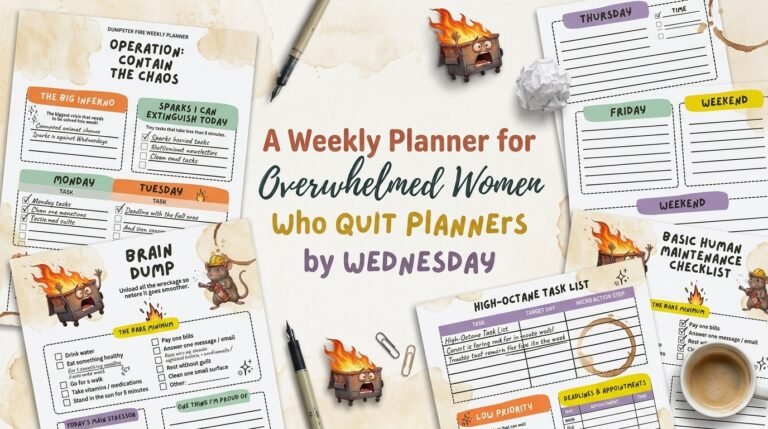
Do A Brain Dump Before You Plan Anything
Get everything out of your head and onto paper before you try to organize anything. Your brain can’t plan clearly while you have 15 unfinished thoughts.
So grab a notebook or a blank note on your phone. Write down every task, worry, and reminder you’re currently thinking about. But don’t try to organize it yet. Just get it all out first.
This works because your working memory can only hold around 5-7 things at once. When you try to plan while your brain is still storing a mental list, you’re working with less capacity than you think.
Just think about it…you can’t sort what you can’t see, and right now, most of it is still stuck in your head. This one thing helped me get more organized the first week I started doing it.
Build One Weekly Planning Session Instead Of Daily Overhauls
Plan your whole week in one sitting instead of trying to figure out your day every single morning.
Pick one day, maybe Sunday evening or Monday morning, and block out 20 minutes. First, look at your brain dump, sort it by what’s most important, and place your essential tasks on specific days.
Planning and time management work best together when you plan everything at once.
Time Block Your Energy, Not Just Your Hours
Plan your hardest tasks to your highest energy windows. Notice when you have more energy during the day. For a lot of busy women, that’s in the morning.
That’s when you should schedule your most demanding task. Save your lower energy hours for simple, low-effort work instead, like:
- Replying to emails
- Folding laundry
- Making phone calls you’ve been putting off
I’ve experienced this myself. I used to do the easy stuff for my business first. Then when it was 2 PM, I struggled to do the necessary things. Lesson learned, and I never did it again.
Batch Similar Tasks Instead Of Switching All Day
This one made a huge change for me. What I started doing is grouping similar tasks and doing them in one sitting. Because bouncing between totally different types of work all day was exhausting me to the point of burnout.
That happens because every time you switch tasks, your brain needs time to catch up.
For example, if you’re paying bills, answering messages, and booking appointments, do all of them back to back.
I’ve read some research, and it showed it can take over 20 minutes to fully refocus after an interruption. Ain’t nobody got time for that, right? 😉
Keep A Simple, Visible System
Choose one system you can see at a glance. Simple is usually better.
This could be a wall calendar, a whiteboard, or a simple notes app if you prefer using your phone. So pick something you’ll actually check without dreading it.
In my opinion, most organization systems fail because they’re too complicated to maintain, not because the person using them isn’t organized enough.
This goes for apps too, if you use them. Juggling 3-5 different tools to organize your life often creates more mental effort than it saves. Ask me how I know hehe 😅
Build In Slack Time On Purpose
Leave open, unscheduled space in your week because you could have one unexpected event that could kick your entire plan out the window.
Think about the last time your whole day fell apart just because one of your kids got sick, or you had to stay at your job 2 hours longer. If your schedule has zero flexibility, that one hiccup ruins your whole daily plan.
If nothing goes wrong (which rarely happens), use it to catch up or just rest.
I believe this is the single biggest reason organization systems fall apart for busy women. A packed schedule with zero room for real life is a setup for disaster…agree?
Let Other People Do Their Part
Hand off tasks fully. Don’t just ask for help and then manage everything. A task you still have to check on isn’t actually off your plate.
If your kids leave toys scattered across the living room, they should be the ones who pick them up, not you. You wouldn’t believe how many times I’ve seen moms say on social media that their kids are too young to clean.
We taught my niece and nephew to do that when they were around 1 year old. Yes, of course we had to keep reminding them to put the toy in the box, and not play with it.
But now they are older, and when I tell them to clean, they do it…with eye rolls hehe. 😝
Let’s also talk about your partner here. If he “helps” with dinner but you’re still the one remembering to defrost the chicken, that’s still a task on your plate.
And don’t fall for the weaponized incompetence. He’s a big boy. He’s totally capable of knowing he needs to take the chicken out of the freezer. Men are not dumb; remember that.
Do A 5 Minute Reset At The End Of Each Day
Spend 5 minutes closing out your day. You deserve to relax.
This tiny habit protects both your evening and your next morning.
Before you’re done for the day, write down 2 things:
- where you left off today
- and what your first task is tomorrow.
This gives your brain a sense of closure. I believe this 5-minute habit is one of the most underrated skills on this whole list. It’s just 2 sentences at the end of your day, but you’ll definitely sleep better. I encourage you to try it out this evening.
Reduce The Visual Noise Around You
Clear the physical and digital clutter in your space. A cluttered desk, an overflowing inbox, or a phone buzzing nonstop all take your focus away.
That doesn’t mean you don’t have to deep clean your whole house. Just clear the surface you’re actually working on.
Try this for one today or tomorrow. Clear your immediate workspace completely before you start a task. Maybe even put your phone in another room.
Attach New Habits To Something You Already Do
Stack a new habit onto a routine you already do automatically. This makes a new habit easier to remember and stick with. I’ve done that before, and I couldn’t believe how fast I got used to it.
So if you want to start planning your day each morning, attach it to something you already do without thinking, like making coffee. After I make my coffee, I plan my business task for the day.
Pick an anchor habit that you’re already doing consistently, like:
- Brushing your teeth
- Making coffee
- Sitting down for lunch
- Getting into your car
Use A Trigger Instead Of Relying On Motivation
Set a specific trigger for a task instead of waiting until you feel motivated enough to start it. Let’s be honest, motivation rarely comes.
So try this: if you usually check social media at 8 AM, maybe add one task that requires you to use your phone. For example, check your emails to see if there are any new updates from your kids’ teachers.
Close The Day With A Real Shutdown Ritual
End your workday with a small, specific ritual. It could be something simple like writing what you didn’t do today and your first task for tomorrow. Or you could do a quick nighttime journaling.
I believe that without some kind of closure, your nervous system stays alert and you keep thinking of something you still have to finish.
But that shutdown ritual lets you relax and wind down.
See Yourself As An Organized Person Already
This is a simple but powerful brain hack. When you already see yourself as an organized person, your brain starts working and acting like that too.
I know it’s a very simple trick, but you’ll have to keep repeating it daily. Claiming the identity now, even before it feels fully true to you, will change the way you organize your life.
Start doing this…pick one small action a day and treat it as evidence:
- You planned your morning – you’re organized.
- You took kids to school on time – that’s what organized people do.
- You scheduled a doctor’s appointment – you guessed it…you’re organized.
If you repeat this proof often, it becomes the identity you were trying to reach in the first place.
Why Most Time Management Advice Doesn’t Work For Busy Women
Most time management advice fails because it’s written for women without kids, or for women whose kids always cooperate. Yeah, that rarely happens. But real life doesn’t work that way.
A sick kid can wipe out your whole morning, a meeting can run one hour longer, and a day can fill up so fast you never even open your planner.
I believe some systems fail because they were built for a version of your week that doesn’t actually exist. So no, you’re not bad at organizing.
You just have to simplify it and try some of the tips I’ve shared in this post. Especially using the slack time where you don’t have anything planned…you know, just in case.
The Real Cost Of Carrying It All In Your Head
Without a system or planner, you’re carrying a job called the mental load. It’s the invisible work of tracking, planning, and remembering everything your household and life need.
- You notice the fridge is empty.
- You remember the appointment.
- You’re the one keeping score for every task your kids need to do.
This runs in the background like an app you can never fully close. That’s exhausting, and it’s hard to explain to anyone who isn’t carrying it too.
I think this is also where a lot of relationship tension starts. When you’re the one remembering everything, it starts to feel unfair, because you’re doing the noticing and the planning even on days when someone else technically “helped.”
So if that keeps happening, sit down and have a deep conversation with your loved ones. Yes, you’re a mom…and an amazing one. But that doesn’t mean you should do everything.
Why Your Free Time Never Feels Like Real Rest
Your leisure time gets shredded into tiny, scattered pieces throughout the day, which is why it never actually feels like real rest.
This is called time confetti, and it happens when your rest gets constantly interrupted by pings, hearing “moooom” for the 37th time in 5 minutes, small requests, and quick little tasks.
You sit down to relax for a few minutes, and you end up checking one email, then a text, then an errand you remembered. By the time you’re done, your rest never actually happened.
That’s why I want you to schedule time for yourself and make it non-negotiable. Tell your kids to play a game called “The Castle Guard Army.”
Here is how it works: The queen (you) goes into another room to rest in the “inner palace chamber.” And your kids are the castle army, but they’re not in the same room with you.
Their mission is to defend the queen from imaginary monsters or invaders for the next 10 minutes. They can march, build fortresses, and deploy their toy troops.
But the most important rule of the game is to never call you for anything (except, of course, if there’s a real emergency).
They have to solve their own problems as a team. So they get to protect the queen, and you get 10 uninterrupted minutes to relax. Try it out…maybe it will work 😉
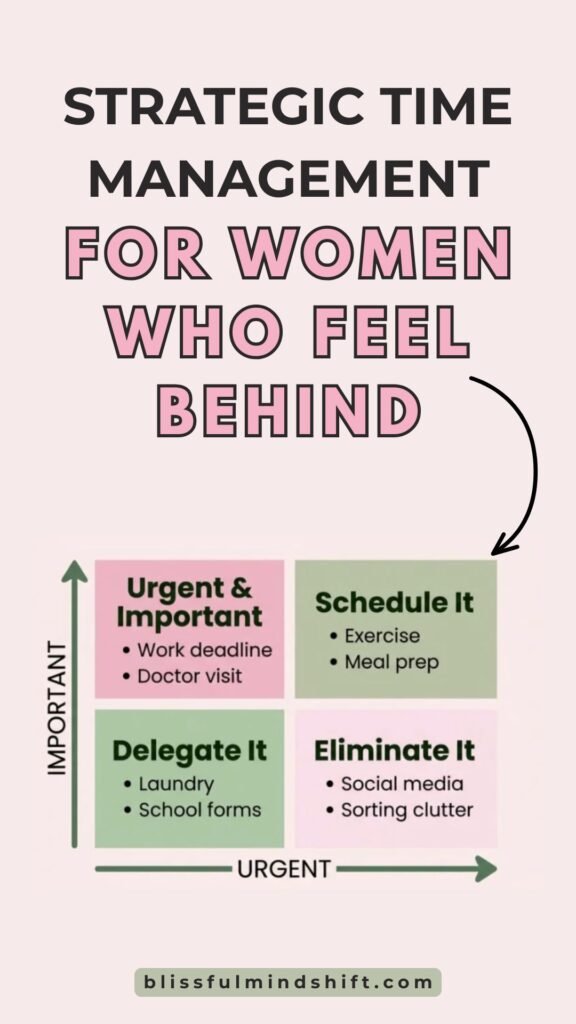
Now let’s look at the framework that will change your life.
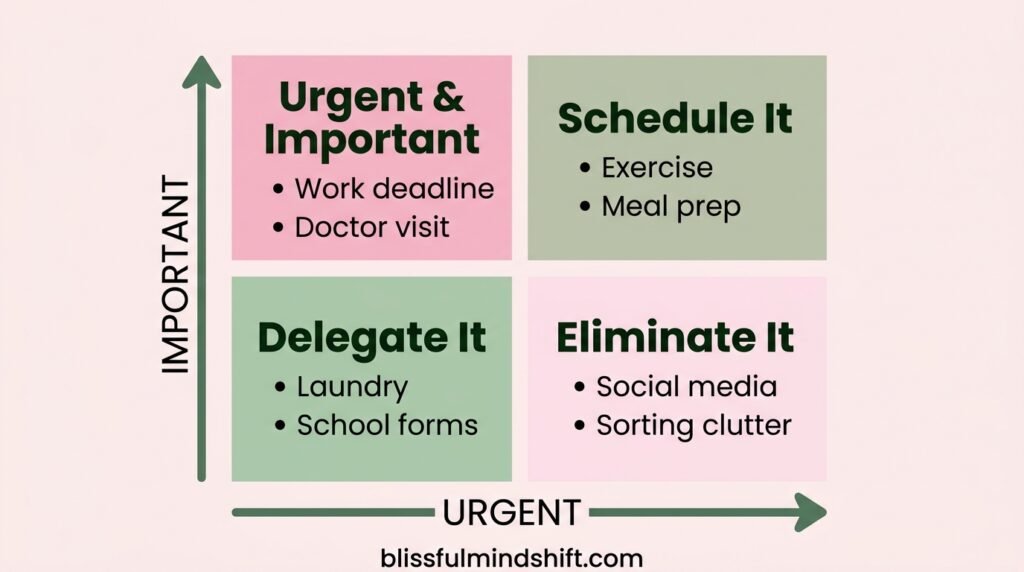
The 4 Quadrants Of Time Management
The 4 quadrants of time management are a simple way to sort your tasks by urgency and importance. This way you stop treating every task like a fire alarm.
Here’s how it works:
How To Stick With Your New System Even When You’re Busy
You stick with a new system by making it flexible enough to be able to change it if necessary.
Give Yourself More Than 3 Weeks
Most habits don’t become automatic in the first 3 weeks as everyone claims. They take somewhere closer to 2 months to actually feel natural. And some of the more complex ones can take even longer.
It depends on what kind of a person you are. But for most of us, it takes some time.
I think this 3-week myth has done a lot of damage to busy women.
And another important thing – if you miss a few tasks or you couldn’t finish them, that’s not proof your system failed. That’s just a normal part of building a new habit.
So stop striving for perfection and rather pat yourself on the back for following through with at least some tasks.
Scale Your System Down On Hard Weeks
When a hard week throws your whole plan out the window, don’t try to catch up on everything at once. That’s a recipe for burnout.
For example, if your kid gets sick, scale your system down to its smallest possible version. If your normal planning session is 20 minutes, do a 5-minute version. Only plan the most essential things for the week and delegate other tasks to your partner.
I believe consistency beats intensity every time. A tiny version of your planning system on a hard week still counts. It’s still you showing up.
Final Thoughts On Organization And Time Management For Busy Women
You don’t need to overhaul your entire life this week. Pick one skill from the list above, and start there.
Maybe it’s the 5-minute brain dump before bed, or a weekly planning session instead of winging it. Maybe it’s handing your kids their own toy cleanup.
The women who get organized long-term aren’t the ones who found the perfect method in the first try. They’re the ones who kept adjusting their system until it works for their life.
So if you fall off for a few days, that doesn’t erase the progress you made. Pick your one thing back up and keep going. That’s what organization and time management for busy women comes down to.