
I used to think shadow work was dangerous. That word “shadow” freaked me out. I pictured something dark I wasn’t ready for. So for years, I avoided it completely.
Then I actually looked into what shadow work for beginners really means. I started journaling with it myself, and I noticed something I didn’t expect.
It felt powerful!
I’m shocked at how much I’d been holding onto without even realizing it. I also learned I’m way different than I thought I was. Yup, be ready to get to know the REAL YOU.
If you’re new to this and a little nervous, you’re in the right place. My guide will walk you through everything, step by step, so you don’t feel lost or overwhelmed.
And don’t worry, I won’t use a bunch of psychology terms. I’m going to explain shadow work the way I wish someone had explained it to me.
This post contains affiliate links (including Amazon Associate links). If you make a purchase through these links, I may earn a small commission at no extra cost to you. As an Amazon Associate, I earn from qualifying purchases. Please read the full disclosure here for more information. I also use AI to help me write, but I tell it exactly what to say based on my experiences.
What Is Shadow Work?
Shadow work is the practice of getting to know the parts of yourself you’ve always wanted to hide.
A psychiatrist named Carl Jung came up with the idea first. He called it “the shadow.” It’s basically the part of your personality you’ve pushed down over the years.
Here’s an easy way to picture it. Think of yourself as an iceberg.
The part above the water is your persona. That’s the version of you people see every single day. But it’s the mask – the traits you’re comfortable showing.
Everything below the water is your shadow. It’s everything you’ve learned to suppress, deny, or disconnect from over time.
I always assumed our shadow was just our negative side. For a long time, that kept me away from this work completely. I didn’t want to sit with all the negative parts of me. But that’s not what your shadow actually is.
Your shadow is actually neutral. It holds the parts of you that got buried, both painful and powerful.
That includes old wounds you never fully dealt with. But it also includes things like your confidence, your creativity, and your real voice.
Why Do We Even Have a Shadow?
You developed a shadow as a kid to survive. When you were little, what mattered most was belonging to your family, not being fully yourself.
So you learned fast which parts of you get approval from your parents and siblings. But you also learned which parts got punished or ignored.
Say you got scolded every time you cried as a kid. You probably learned to shove that feeling down. Over time, that becomes automatic, and you stop noticing it.
And that doesn’t mean there’s something wrong with you. That’s just how your brain kept you safe back then.
Your shadow is really just a leftover survival skill.
Let’s look at some other examples:
- Maybe you grew up in a house full of conflicts. You might have learned to stay quiet to avoid making things worse.
- Or maybe you watched a parent struggle with something, so you learned to take care of everyone else instead of yourself.
Those patterns made sense back then because they kept you safe. The problem is they don’t just disappear once you become an adult. They’re stuck until you resolve them.
You’ll also love these 30 Deep Shadow Work Journal Prompts For Self Love.
Is Your Shadow Just the Negative Part of You?
No, your shadow isn’t only the bad stuff inside you. It’s actually morally neutral.
Yes, it holds your wounds, your fears, and the things you’re ashamed of. But it also holds something called your golden shadow.
That’s the good stuff you hid too. Things like your confidence, your playfulness, your personal power. Traits you learned to shrink because they made you stand out too much.
Maybe you were told you were “too much” as a kid for being excited or expressive. So you learned to tone yourself down.
But that confident, playful part of you didn’t disappear. It just got buried alongside everything else. So yes, you can get it back.
And this is why I believe shadow work is the most essential part of mindset work. It’s not about digging up everything wrong with you. It’s about meeting the whole version of yourself, the good parts included.
How Do You Know Your Shadow Is Running the Show?
You’ll know your shadow is in charge when your reaction feels way too big for the situation you’re in.
Your shadow tends to show up in 3 main ways:
- Emotional triggers: Something small happens, but you react way too hard. Let’s say your partner doesn’t text you back for a few hours because their battery died. Suddenly you feel completely unloved and start spiraling.
- Projection: You get intensely irritated by a trait in someone else. For example, a coworker speaks up confidently in a meeting, and it bugs you. That might actually be your own buried desire to take up space.
- Patterns you keep repeating: You procrastinate on the same goal over and over and over again. You keep choosing partners who aren’t emotionally available. You people-please until you’re completely drained.
I saw the same patterns showing up in my life for years. I tried fixing it externally. I tried staying positive about all of it. But neither of those things worked.
That’s when I finally started with the shadow work. I got sick of watching the same situations repeat.
Is Shadow Work the Same as Therapy?
No, shadow work is not the same as therapy, though the two can work well together.
- Therapy usually involves a trained professional guiding you through what comes up in the session.
- Shadow work is something you can do on your own, at your own pace, with a journal.
Think of it as a self-guided tool for noticing your own patterns. It’s not a replacement for professional support if you need it. Plenty of people use both.
So if you have deep trauma or a diagnosed condition, talk to a therapist first. Shadow work can be a great companion to that process. It’s just not a substitute for it.
How Do You Start Shadow Work?
You start shadow work by creating a space where you feel safe. It could be in your bed, in your home office, or anywhere else.
And yes, the space matters because shadow work can bring up a lot of mixed emotions. So as a beginner, you might get overwhelmed. But that cozy area can calm you down.
If you’re wondering how to start shadow work the right way, it comes down to preparation first. Here’s what I’d set up before your first session:
- Find a private spot. Somewhere quiet where nobody’s going to walk in on you. Lock the door if that helps you relax and feel secure.
- Get a notebook and a pen. A physical one or a digital journal both work fine. I use both.
- Keep something comforting nearby. A blanket, tea, candles, or anything that calms your body. Have it ready in case things get intense.
- Set a pomodoro timer for 10-20 minutes. Maybe keep your first sessions short. Shadow work can be tiring.
Stay curious, not critical. You’re not trying to fix yourself. You’re just getting to know parts of you that got pushed aside a long time ago.
None of this needs to be fancy. I’ve done some of my best shadow work sessions with a piece of paper and my phone timer.
How Do You Do Shadow Work Step By Step?
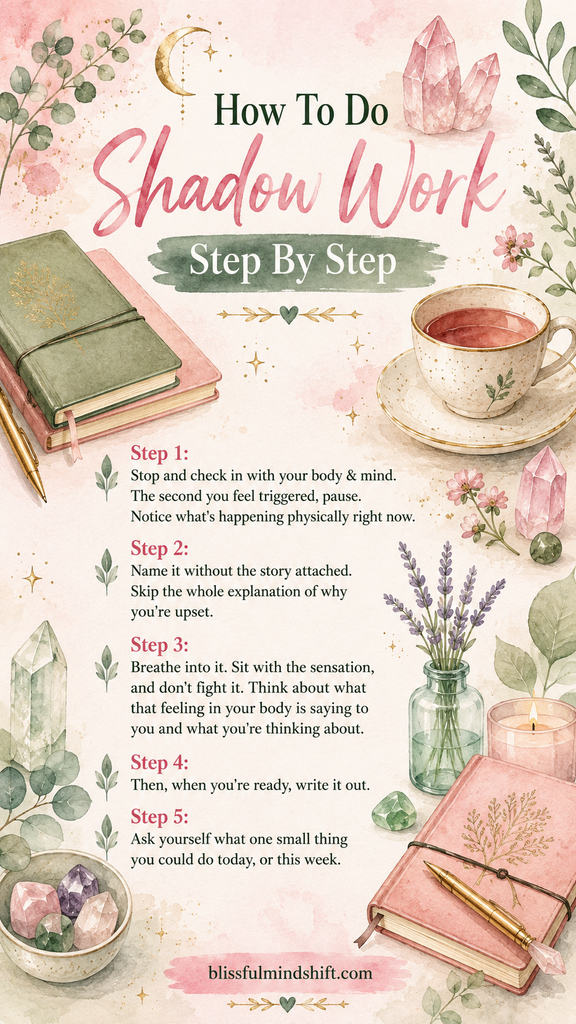
Here’s the exact process I use whenever something sets me off:
- Step 1: Stop and check in with your body & mind. The second you feel triggered, pause. Put your pen down for a second. Notice what’s happening physically right now. Maybe your chest feels tight, or your breathing goes shallow. Maybe your jaw or fists are clenched.
- Step 2: Name it without the story attached. Skip the whole explanation of why you’re upset. Just name what’s actually there. Try something like, “My chest feels tight, and I feel shame.”
- Step 3: Breathe into it. Sit with the sensation, and don’t fight it. Slow breathing will help your nervous system calm down. Think about what that feeling in your body is saying to you and what you’re thinking about.
- Step 4: Then, when you’re ready, write it out. Free-write for those 10 minutes, and don’t edit anything. Don’t worry if it sounds petty or dramatic. Just let it be REAL.
- Step 5: Turn it into one small action. Ask yourself what one small thing you could do today, or this week. For example, if you noticed a people-pleasing pattern, try saying NO to something you really don’t want to do. And don’t over-explain yourself.
What Are Some Shadow Work Prompts for Beginners?
Shadow work prompts for beginners are journal questions built to help you notice old patterns. I’ve put together different ones below that cover your childhood, your relationships, and your self-worth.
My advice is to pick one prompt per session. You don’t want to overwhelm yourself, because then you won’t do it daily.
Childhood patterns:
- What feeling did I get in trouble for showing as a kid, and what do I do with that same feeling today?
- What’s something I wish a parent or caregiver had said to me growing up, but never did?
- What “job” did I have in my family without ever being asked (fixer, quiet one, mediator, black sheep)? Am I still doing that job?
- Is there a moment from childhood that still stings when it crosses my mind? What actually happened?
- Growing up, was I taught to handle things on my own, or was help okay to ask for? What did that teach me about leaning on people now?
- As a kid, what happened when I got upset in front of the adults around me? Is that how I treat myself now when I’m upset?
- By the time I was 10, what had I already decided about my own worth or capabilities, without ever really questioning it?
- What sides of myself did I learn to hide or perform just to stay safe and accepted in my own home?
- How did my house handle conflict when I was little? Do I now run from it, stir it up, or shut down completely?
Relationships:
- What trait in other people gets under my skin the fastest? Could that be something I recognize in myself, even quietly?
- What do I privately criticize the people closest to me for? What does that reveal about the standards I hold myself to?
- When someone crosses a line with me, what’s my go-to move? Do I shut down, lash out, freeze, or just go along with it?
- If someone got close enough to really see me, what would I be most afraid they’d find out?
- What do I need from other people that I never think to give myself?
- Which boundary is the one I always struggle to hold? What am I scared will happen if I actually enforce it?
Self-worth:
- What do I think has to happen before I’m allowed to feel worthy or lovable?
- When that harsh inner voice shows up, who does it actually sound like?
- What kind of praise makes me squirm the most, and why can’t I just take it?
- What good thing do I believe isn’t meant for me, and where did I first pick up that belief?
- When life starts going well, how do I quietly mess it up for myself?
- When I stack myself up against someone else, what do I assume they have that I never will?
Avoided emotions:
- Which emotion do I basically never let myself fully sit in, and what makes that one feel so unsafe?
- When something vulnerable comes up, what do I reach for instead of just feeling it?
- What emotion scares me the most to actually experience? What am I afraid would happen if I let it in?
- Where does my body usually carry stress or tightness? What might it be trying to flag for me?
- What parts of myself have I disowned or kept hidden, and what would it look like to be gentler with them today?
- When I mess up, what’s the first thing that runs through my head? What would it sound like if I said something kinder instead?
I noticed patterns show up almost every time I use these prompts. Little things I never connected before started making sense.
If you want more prompts than what’s here, I’ve got you. I put together 600+ Shadow Work Prompts across 35 topics. It covers everything from boundaries and self-sabotage to inner child healing and self-worth. Each topic comes with a short breakdown. That way you know exactly what you’re working through and why.

600+ Shadow Work Prompts Across 35 Different Topics
You’ll get to know the parts of yourself you’ve been avoiding, and you’ll finally permit yourself to like ALL of you.
How Often Should You Do Shadow Work?
You should do shadow work as often as you can stay consistent. I would recommend daily, so it becomes a habit.
I’ve been doing this consistently for a while now. Even one prompt a day can help you change your life.
Some days I only do 1-2 prompts. Other days I do more. Either way, I keep showing up.
When Should You Pause Shadow Work?
You should pause shadow work if you feel frozen, numb, or completely disconnected from your body.
There’s a real difference between productive discomfort and something more serious.
Productive discomfort feels tender, but you’re still fully present. You can feel the emotion and sit with it.
But retraumatization feels different. You might feel frozen, panicked, or totally checked out from your own body.
If that happens, stop right away. Try the 5-4-3-2-1 method:
- Name 5 things you see,
- 4 you can touch,
- 3 you hear,
- 2 things you smell
- and 1 you taste.
If you’re dealing with active trauma, PTSD, or severe depression, please don’t do this completely alone. Work through shadow work alongside a trauma-informed therapist instead.
I’d rather tell you the truth. I don’t want you going through something you’re not ready for alone. Your safety always comes first.
What Changes After You Start Doing Shadow Work?
You’ll probably notice yourself reacting less automatically to the same old triggers.
For example, that coworker email that used to ruin your whole afternoon will start to feel like just an email.
You’ll also start catching your own patterns earlier. Instead of realizing it 3 months into a relationship, you notice it in week 1.
But none of this will happen right away. I want to be honest with you about that. You’ll need to be patient.
It’s more like SLOWLY getting your real self back. Piece by piece, you get to know parts of yourself you spent years avoiding.
And you start giving yourself permission to like all of it.
Is Shadow Work Worth Doing?
In my opinion, yes. Shadow work is worth doing if you’re tired of repeating patterns that keep hurting you.
- You start catching your own reactions before they take over your life completely.
- You stop being so hard on yourself.
- You get to actually like all of YOU.
That’s the whole point of shadow work for beginners. It’s not about perfection, but about honesty and doing the work daily.
I wasted years avoiding this because I thought it was all about the negative parts of yourself. So don’t repeat my mistake.
If you’re ready to go deeper, grab my 600+ Shadow Work Prompts pack. It’s a resource you can come back to for months or even years.
Now grab your notebook, pick a topic that’s calling to you, and start today.
600+ Shadow Work Prompts Across 35 Different Topics
You’ll get to know the parts of yourself you’ve been avoiding, and you’ll finally permit yourself to like ALL of you.